Used-Car Auction Vehicle Inspection Scorecard
Auction lanes run on a clock that nobody controls. Every vehicle that stalls at the inspection bay pushes the whole run-list back, and every condition report that a remote buyer distrusts turns into an arbitration case weeks later. Most procurement teams compare inspection systems with feature checklists that treat all capabilities as equally important. A weighted scorecard forces the comparison to reflect what actually constrains your operation.
At a Glance
Score every candidate inspection system out of 100 points across seven weighted criteria. The weights below reflect the operational reality of a high-volume used-car auction, where lane speed and buyer-trusted evidence dominate the outcome and everything else supports them.
| # | Criterion | Weight | What the score measures | Data column to record |
|---|---|---|---|---|
| 1 | Lane throughput | 25 | Vehicles processed per hour per lane without manual re-runs | Measured cycle time, seconds per vehicle |
| 2 | Evidence quality | 20 | Whether captured output survives buyer challenge and arbitration | Resolution and capture conditions per zone |
| 3 | Inspection coverage | 15 | Proportion of the vehicle actually captured, including undercarriage | Zones covered out of zones required |
| 4 | System integration | 12 | Fit with your AMS, run-list, VIN decode, and listing pipeline | Available API endpoints and export formats |
| 5 | Data control | 10 | Ownership, retention, residency, and export of your inspection data | Retention period and export format |
| 6 | Deployment fit | 10 | Physical, power, and civil-works fit for your existing lanes | Footprint, power draw, mounting method |
| 7 | 360 merchandising | 8 | Reuse of inspection capture as online listing content | Output formats delivered per vehicle |
Total the seven weighted scores to compare candidates consistently, then apply auction-defined veto thresholds for any requirement that cannot be compromised.
How to Score Each Criterion
Score each criterion from 0 to 10, then multiply by the weight and divide by 10. Use your own lane data as the benchmark rather than the vendor's demo conditions.
-
Time a real drive-through, not a staged one. Measure from the moment the vehicle enters the capture zone to the moment a usable report exists. Elscope Vision's 4-in-1 inspection system produces a combined report within tens of seconds of the drive-through, which sets a practical reference point for what a modern lane cycle can look like.
-
Inspect the raw evidence, not the summary. Ask to see full-resolution undercarriage frames and panel imagery from a vehicle you selected at random that morning.
-
Count the zones. A system that captures exterior panels but not the undercarriage leaves the highest-arbitration-risk area undocumented.
-
Test the integration path with your own VIN set. A vendor that can only deliver a PDF is not integrated.
-
Read the data clause before the spec sheet. Confirm who owns the imagery and how you export it if you change vendors.
-
Walk the physical lane with the deployment drawings. Check overhead clearance, drainage, and power availability at the actual bay.
-
Pull the merchandising output into your listing template and look at it on a phone.
Criterion 1: Lane Throughput, 25 Points
Throughput is weighted highest because it is the only criterion that compounds across every vehicle in the run-list. A system that adds thirty seconds per vehicle costs a 400-car sale day more than three hours of lane time.
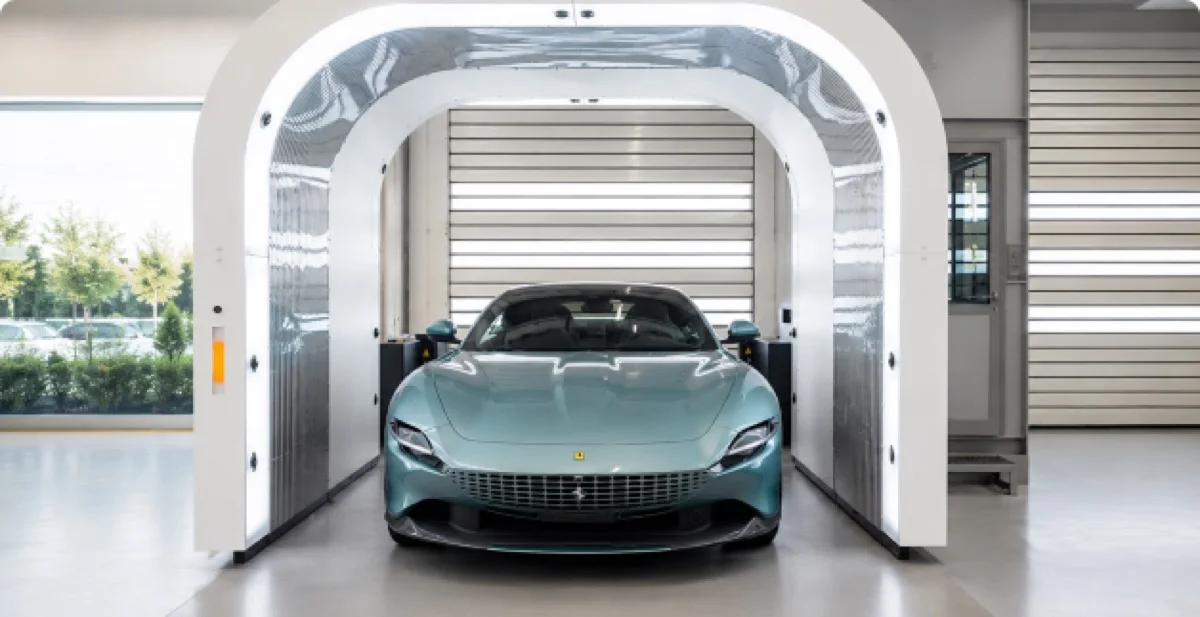
Score a candidate at the top of the range only if it captures at drive-through speed without stopping the vehicle, requires no operator repositioning, and produces its report before the next vehicle enters the bay. Elscope Vision's Dragate drive-through system is built around this constraint, using a 17-camera array to capture the vehicle in a single pass rather than in staged positions.
Criterion 2: Evidence Quality, 20 Points
Evidence quality determines whether a condition report holds up when a remote buyer disputes it. The criterion covers image resolution, lighting consistency, and whether the capture is reproducible in poor weather and low ambient light.
• Undercarriage frames must be sharp enough to distinguish surface corrosion from structural damage.
• Panel imagery must render dents and paint defects under controlled illumination rather than ambient lane lighting.
• Every frame should carry a VIN, timestamp, and lane identifier so the evidence is attributable.
• Captures must be repeatable across shifts, not dependent on a skilled operator.
Elscope Vision combines Dragate exterior capture with TOTA underbody scanning so body and undercarriage evidence can be reviewed in one workflow.
Criterion 3: Inspection Coverage, 15 Points
Coverage is measured as zones captured against zones your arbitration policy requires. Most auctions define a required zone set across exterior panels, glass, wheels and tires, and the undercarriage. Score coverage against your own arbitration history: if half your disputes concern undercarriage condition, a system without undercarriage capture cannot score above the midpoint.
Criterion 4: System Integration, 12 Points
The inspection system must push structured data into the systems that already run your sale. Ask specifically for VIN-keyed record creation, image delivery to your listing platform, and condition data in a structured format your AMS can ingest. Score a candidate low if integration means manual re-entry, no matter how good the capture is.
Criterion 5: Data Control, 10 Points
Your inspection archive is a long-term asset. Confirm retention periods, storage location, export format, and what happens to historical records at contract end. Systems offering on-premise or customer-controlled storage score higher than closed cloud-only arrangements.
Criterion 6: Deployment Fit, 10 Points
Score the physical fit against your existing lane rather than an ideal installation. Consider footprint, mounting method, power requirements, drainage for undercarriage units, and whether the lane must be taken out of service during installation. A system that requires rebuilding a bay carries real opportunity cost in lost sale days.
Criterion 7: 360 Merchandising, 8 Points
Inspection and merchandising outputs should connect without manual file handling. SKEYE provides a separate 360 display capture for buyer-facing listings, while the inspection lane produces the internal condition record. Score this criterion on output formats and whether both records join the same vehicle listing without re-editing.
Applying the Scorecard
Run every candidate through the same seven criteria using the same vehicles on the same day. Record the raw data column for each criterion so the comparison is auditable later. Weighted scores expose trade-offs that feature lists hide: a system with outstanding evidence quality but weak integration will often score below a more balanced alternative, because unintegrated evidence still requires manual handling on every vehicle.
Review Dragate drive-through capture, TOTA underbody scanning, and the SKEYE 360 display workflow against the same scorecard.
FAQ
**What is the single most important criterion for an auction?**Lane throughput. It carries 25 of the 100 points because delay compounds across every vehicle in the run-list, while other weaknesses affect only the vehicles they touch.
**Should the weights change for a smaller auction?**Yes. An auction running under 100 vehicles per sale day can reduce throughput to 15 points and move that weight to evidence quality and 360 merchandising, where remote-buyer confidence matters more than lane speed.
**Does a high score guarantee a fit?**No. Treat any score below 6 out of 10 on an individual criterion as a veto condition even if the total is strong, because a single failed criterion usually becomes a daily operational problem.
**How many vehicles should a trial cover?**Enough to include your normal condition spread. A trial limited to clean, recent-model vehicles will not reveal how a system handles corrosion, prior repair, or heavy soiling.
Build Your Own Scorecard
Take the seven criteria, adjust the weights to match your own lane volume and arbitration history, and score every candidate against the same vehicles. If you want to see how Elscope Vision systems perform against your criteria, contact the team to arrange an evaluation on your own lane.
